INTERFACE
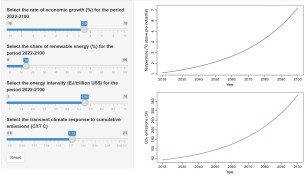
This web interface allows you to use the DEFINE-CLIMATE model to explore how climate change is affected by the following key factors:
-
The rate of economic growth after 2022. With everything else given, the higher the rate of growth the higher the use of non-renewable energy and the higher the generation of carbon emissions. The default value is 2.9%.
-
The share of non-fossil energy in total energy after 2022. An increase in this share has a favourable effect on climate change because it permits the production of goods and services without relying on fossil fuel combustion. The default value is 14% which is close to the current share of non-fossil energy.
-
The energy intensity after 2022. This is defined as the use of energy (in exajoules) per GDP (trillion US$, 2017 prices). The higher the level of energy intensity the more adverse the impact of economic activity on climate change. The default value is 6.86 exajoules per trillion US$, which is close to the current level of energy intensity.
-
The transient climate response to cumulative emissions. This is defined as the increase in atmospheric temperature per 1 Teratonne (or 1000 Gigatonnes) of cumulative carbon emissions. The default value is 1.72 oC/Tt C.
Note: DEFINE-CLIMATE does not include the feedback effects of climate change on economic growth and the use of energy. Such effects are incorporated in DEFINE-GLOBAL.
 DEFINE